Hello! Minasan! Welcome to "Dictation for Every Day" (D4E: version 5) a.k.a. Mainichi no Kikitori
Workbook
PDF Workbook (volume 1, 2, and 3) is available from
[here]!
It includes the notes of words, phrases and grammars.
News and Story
2024.07.14: Volume 3, episode 101-150 starts.
An episode is updated every day.
A.E.A.D. (An Expression A Day)
If you want to learn Japanese expressions more,
visit the A.E.A.D. (An Expression A Day) page:
AEAD Search.
2026.09.24 Thu #897: Yeah, I kind of figured.
うすうす、気づいてた
Ususu, kizuiteta.
Yeah, I kind of figured.
A「わたしたち、付き合ってるんです」 B「うん、うすうす、気づいてた」
A: We're seeing each other. B: Yeah, I kind of figured.
"Ususu, kizuiteta" is used when a fact is explicitly revealed and the speaker indicates that they had already weakly suspected or sensed it beforehand. "Ususu" does not simply mean "a little"; it suggests that the speaker had picked up on various signs or clues but had not yet reached full certainty. Once the other person states the fact clearly, the speaker's previously uncertain awareness becomes confirmed, and the speaker can retrospectively say that they had already noticed something was going on. In the example, the speaker had sensed from the couple's behavior that they might be together, but the matter remained unconfirmed until they said so directly. The initial "un" signals calm acceptance rather than surprise, fitting a situation in which the information was already partly expected. "Nantonaku kizuiteta" is similar, but "ususu" more strongly suggests that weak awareness had gradually formed from accumulating signs.
2026.09.23 Wed #896: Oh, you're right.
あ、ほんとだ
A, honto da.
Oh, you're right.
A「それなら、先週、勉強したよ」 B「あ、ほんとだ」
A: In that case, we studied it last week. B: Oh, you're right.
'A, honto da' is an immediate expression used after the listener points something out and the speaker checks it for themselves and realizes that it is indeed true. 'A' marks the moment when the speaker's new understanding is established through confirmation. 'Honto da' does not simply accept the listener's statement as an opinion; it indicates that the speaker has compared the statement with the available facts or evidence and has independently recognized it as true. For this reason, the expression differs from a general agreement such as 'Sou desu ne.' It specifically conveys the sense of 'I just checked, and now I see that it really is true.' What has been confirmed does not need to be repeated because it is clear from the immediately preceding utterance. In the example, a previously registered expression is almost treated as a new candidate, but after being told that it already exists as No.854, the speaker checks and immediately responds, 'A, honto da.' The expression itself arose naturally during the AEAD work.
2026.09.22 Tue #895: Oh, this might work.
あ、いけそう
A, ikesou.
Oh, this might work.
A「それ、入る?」 B「うーん...あ、いけそう」
A: Will that fit? B: Hmm... oh, this might work.
'A, ikesou' is an immediate expression used during an attempt when speakers realize that success has not yet been achieved but now appears possible from the current situation or feedback. 'A' marks the moment when the speaker notices the possibility of success. Here, 'ikeru' does not mean being able to go somewhere; it means that a method may work or that something may be feasible. 'Sou' indicates a judgment based on what the speaker can currently observe, before the result has been confirmed. For this reason, 'A, ikesou' does not report success itself. It expresses an immediate prediction made when signs of possible success appear during an ongoing attempt. Unlike No.853, 'A, iketa,' which confirms that an attempt has actually succeeded, 'A, ikesou' belongs to the immediately preceding stage, when the speaker judges that success now looks likely. In the example, the speaker is trying to fit something into a space and, after making an adjustment, realizes that it may now fit and responds, 'A, ikesou.'
2026.09.21 Mon #894: Actually, never mind.
あ、やっぱやめた
A, yappa yameta.
Actually, never mind.
A「カレーにする?」 B「うん。あ、やっぱやめた。そばにする」
A: Are you going to have the curry? B: Yeah. Actually, never mind. I'll have the soba.
'A, yappa yameta' is used when speakers have just chosen something or decided to do something but reconsider immediately before carrying it out and withdraw that choice or action on the spot. 'A' marks the moment when the change of mind occurs. 'Yappa,' the conversational form of 'yappari,' connects the new decision with the speaker's immediately preceding judgment or with an alternative that had already been present in the background. Although 'yameta' has past-tense form, it does not primarily report an earlier event here. Instead, it performs a decision at the present moment: the speaker has now decided not to proceed. The expression therefore contains a short temporal sequence: a choice is made, reconsideration occurs just before execution, the choice is withdrawn, and the speaker shifts to another course of action. In the example, B initially chooses curry but changes their mind before ordering, says 'A, yappa yameta,' and switches to soba.
A: Could you give me a hand on Sunday? B: Sunday's a little difficult... A: I'll treat you to eel for lunch. B: **Oh, that changes things.**
"A, sore nara hanashi wa betsu" is used when newly supplied information changes the speaker's judgment on the spot. "Sore nara" immediately takes the preceding information as a new condition, while "hanashi wa betsu" signals that the situation must now be evaluated differently. Here, "hanashi" does not literally mean a story or conversation; it refers more broadly to the matter under consideration. The expression is often used lightly or humorously when an unexpected favorable condition changes the speaker's attitude.
Let's practice every day!
Let's learn Japanese through dictation practice!
PDF Workbook (volume 1 and 2) is available from
[here]!
It includes the notes of words, phrases and grammars.
This is the dictation practice site operated by Japanese Language Teaching Section, Tokyo Institute of Technology.
This practice involves a variety of natural expressions in daily conversation.
You can practice 10 sentences a day depending on your language ability.
It's a very simple exercise. You just follow the audio you hear and type in Roman letters.
Your comments and bug reports are very welcome. Please submit from here.
Zen and the Art of Dictation
Let's learn Japanese through drill and practice!
You will practice 10 sentences in an episode.
It's a very simple exercise.
You just follow the audio you hear and type in roman letters.
The first objective is to learn the basic Japanese sounds
and hiragana/katakana combinations.
You can practice as many times as possible.
The more you practice, the better you will get.
Please regularly contribute your time to this practice.
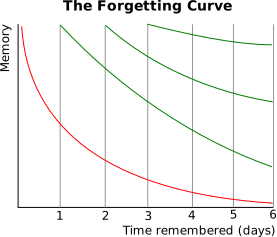
It is important to practice every day rather than to practice a lot at once.
The following is the psychological evidence of the importance of regular practice:
Figure 1: The forgetting curve described by Hermann Ebbinghaus.
Here, b represents 'Savings' expressed as a percentage, and t represents time in minutes, counting from one minute before end of learning. The constants c and k are 1.25 and 1.84 respectively. Savings is defined as the relative amount of time saved on the second learning trial as a result of having had the first. A savings of 100% would indicate that all items were still known from the first trial. A 75% savings would mean that relearning missed items required 25% as long as the original learning session (to learn all items). 'Savings' is thus, analogous to retention rate.
 Drill for Every Day (D4E: V5)