Hello! Minasan! Welcome to "Dictation for Every Day" (D4E: version 5) a.k.a. Mainichi no Kikitori
Workbook
PDF Workbook (volume 1, 2, and 3) is available from
[here]!
It includes the notes of words, phrases and grammars.
News and Story
2024.07.14: Volume 3, episode 101-150 starts.
An episode is updated every day.
A.E.A.D. (An Expression A Day)
If you want to learn Japanese expressions more,
visit the A.E.A.D. (An Expression A Day) page:
AEAD Search.
2026.08.12 Wed #854: Oh, it went through.
あ、通った
A, tootta.
Oh, it went through.
A「もう一回、パスワード入れてみて」 B「うん...あ、通った」 A「よかった」
A: Try entering the password one more time. B: Okay... oh, it went through. A: Good.
'A, tootta.' is an immediate expression used when speakers realize that something requiring acceptance or clearance, such as authentication, a payment, an application, or a communication process, has successfully gone through. 'A' marks the moment when the speaker notices that the process has succeeded. Here, 'tooru' does not refer to a person or object physically passing through a place. Instead, it describes an input, request, or process passing a check or condition and being accepted. What has passed and what it has passed through do not need to be stated because they are evident from the ongoing operation or the result shown on the screen. Unlike No.853, 'A, iketa,' which confirms that an uncertain attempt itself has worked, 'A, tootta' focuses on something having passed a check, condition, or other gate. In the example, the speaker enters the password again and says 'A, tootta' at the moment the screen shows that the authentication has succeeded.
2026.08.11 Tue #853: Oh, it worked.
あ、いけた
A, iketa.
Oh, it worked.
A「もう一回、やってみて」 B「うん...あ、いけた。」 A「よかった」
A: Try it one more time. B: Okay... oh, it worked. A: Good.
'A, iketa.' is an immediate expression used when speakers try an operation or method whose success is uncertain and realize at that moment that it has worked. 'A' marks the moment when the speaker notices the successful result. Here, 'ikeru' does not mean being able to go somewhere; it means that something can work, can be done, or is feasible in the situation. For this reason, 'iketa' differs from the more general 'dekita' (I did it / It's done). 'Iketa' is especially natural when the speaker first tries something without knowing whether it will work and then confirms its success from the result. What has worked does not need to be stated because it is evident from the ongoing action or immediately preceding attempt. In the example, the speaker tries an operation again after it previously failed and says 'A, iketa' at the moment they realize that it has now worked.
2026.08.10 Mon #852: That's a relief.
これで一安心
Kore de hitoanshin.
That's a relief.
A「荷物、無事に届いたって」 B「これで一安心」
A: They said the package arrived safely. B: That's a relief.
'Kore de hitoanshin.' is an immediate expression used when something the speaker has been worried about is resolved or moves into a sufficiently safe state, allowing the speaker to feel relieved. 'Kore de' points to the event that has just occurred and marks it as the reason the speaker can now move from worry to relief. 'Hitoanshin' does not necessarily mean that every problem has been completely solved; rather, it indicates that at least the immediate concern has been settled for the time being. What has been resolved does not need to be stated explicitly because it is understood from the shared situation. In the example, the speaker learns that the package they were worried about has arrived safely and immediately responds, 'Kore de hitoanshin.'
2026.08.09 Sun #851: Acting as if nothing happened.
しれっと
Shiretto.
Acting as if nothing happened.
A「さっきあんなに怒られたのに、しれっと戻ってきたね」 B「ほんとだ」
A: Even after getting scolded like that, they came back as if nothing had happened. B: They really did.
'Shiretto' is an immediate expression used when the speaker notices someone behaving as though nothing had happened. It does not simply mean 'naturally' or 'casually.' It often carries the nuance that the person is acting with mild cheekiness or audacity, as if the previous incident could simply be ignored. Unlike 'secretly,' which focuses on hiding an action, 'shiretto' describes behaving openly and calmly despite circumstances that would normally make such behavior awkward. What has been glossed over is left unstated because it is understood from the shared situation.
2026.08.08 Sat #850: Oh, it's the other way around.
あ、逆だ。
A, gyaku da.
Oh, it's the other way around.
A「これをここに差して...あ、逆だ」 B「反対向きだね」
A: Put this in here... oh, it's the other way around. B: Yeah, turn it around.
'A, gyaku da.' is an immediate expression used when speakers notice that the direction, orientation, or order of something is reversed and correct themselves on the spot. 'A' marks the moment of realization, signaling an immediate shift in the speaker's understanding. 'Gyaku da' does more than indicate that something is wrong: it identifies the error as a reversal of direction, orientation, or order. What exactly is reversed does not need to be stated because it is apparent from the object or action shared in the immediate situation. Unlike No.849, 'A, chigau,' which generally cancels the speaker's preceding judgment or action upon noticing an error, 'A, gyaku da' immediately identifies the specific type of error as a reversal. In the example, the speaker notices while trying to insert an object that it is facing the wrong way, says 'A, gyaku da,' and immediately corrects its orientation.
Let's practice every day!
Let's learn Japanese through dictation practice!
PDF Workbook (volume 1 and 2) is available from
[here]!
It includes the notes of words, phrases and grammars.
This is the dictation practice site operated by Japanese Language Teaching Section, Tokyo Institute of Technology.
This practice involves a variety of natural expressions in daily conversation.
You can practice 10 sentences a day depending on your language ability.
It's a very simple exercise. You just follow the audio you hear and type in Roman letters.
Your comments and bug reports are very welcome. Please submit from here.
Zen and the Art of Dictation
Let's learn Japanese through drill and practice!
You will practice 10 sentences in an episode.
It's a very simple exercise.
You just follow the audio you hear and type in roman letters.
The first objective is to learn the basic Japanese sounds
and hiragana/katakana combinations.
You can practice as many times as possible.
The more you practice, the better you will get.
Please regularly contribute your time to this practice.
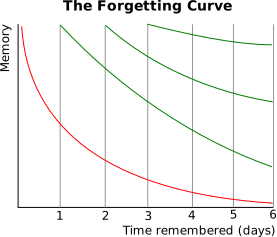
It is important to practice every day rather than to practice a lot at once.
The following is the psychological evidence of the importance of regular practice:
Figure 1: The forgetting curve described by Hermann Ebbinghaus.
Here, b represents 'Savings' expressed as a percentage, and t represents time in minutes, counting from one minute before end of learning. The constants c and k are 1.25 and 1.84 respectively. Savings is defined as the relative amount of time saved on the second learning trial as a result of having had the first. A savings of 100% would indicate that all items were still known from the first trial. A 75% savings would mean that relearning missed items required 25% as long as the original learning session (to learn all items). 'Savings' is thus, analogous to retention rate.
 Drill for Every Day (D4E: V5)